
Member Mixer – What Camera Companies Get Wrong
Join us for this week’s TWiP Member Mixer! AI autofocus is incredible. Retro designs are selling. But camera companies are still dropping the ball — and tonight we’re calling it out.
Discussion Recap
Tonight we had a fantastic sprawling, opinionated conversation that went well beyond the original topic. We started with what camera companies get wrong — and ended up covering everything from AI ethics in photography to Adobe’s declining stock price to cherry blossoms and broken ankles.
The Gear Talk
Peter kicked things off eyeing the new DJI Avatar 360 — 8K, 60fps, 10-bit HDR. His first drone ever, potentially. The catch? 15-minute battery life and the 450g weight means commercial licensing and insurance in Australia. Marc’s been deep into 360° workflow and C2PA authentication challenges. The group got into GPS (still missing from most cameras), intervalometers (some have them, many don’t), and the Peak Design tall carbon fiber tripod that Peter swears by — “eight hundred bucks but outstandingly good.”
Stephen Johnson on Photography, Truth, and AI
The evening’s standout conversation came from Stephen Johnson, who brought decades of perspective on imaging ethics. Stephen — who keynoted the first Photoshop conference in 1995 with “Imaging Ethics in the Digital Age” — shared his philosophy: “The world’s already self-embellished. It doesn’t need enhancing.”
He told the story of stitching together offset panoramic frames from Big Bend, Texas (1997), and using AI fill to complete the missing pieces. The result looked great. He had zero interest in it. “It was no longer a photograph. It was computer synthesis mixed with my photographs.”
On AI in his own work: he uses it weekly to create anti-Trump protest posters (printed on canvas, carried at marches), but draws a hard line at using it in his photography. His position hasn’t changed since 1995.
A memorable exchange with Peter about truth in photography: “All photographs are a lie” is nonsense, Stephen argued. “They’re a light-based impression of what was in front of the lens at that particular moment, which makes it among the most truth-telling mediums there is.”
His advice on disclosure: “Do anything you want, but just tell your viewer what they’re looking at.”
What Camera Companies Actually Get Wrong
- Computational features are underutilized. Cameras have massive compute power but use it for basics. Stephen pointed out phones still have more computational capability than most cameras, despite being general-purpose devices.
- Reliable wireless tethering. Marc: “Insta360 is getting it pretty damn solid. If they can figure it out, why can’t everybody else?”
- GPS should be standard. Stephen’s been asking for this since the mid-90s when he was using a physical compass alongside early GPS units for his national parks project.
- Intervalometers missing from many bodies. Peter: “A fucking intervalometer in each camera would be bloody good, too, instead of having to pay for it.”
- Zoom lens locks. Marc wants the ability to lock a zoom at any focal length — currently uses gaffer’s tape. The Tamron 150-600 has a sliding zoom lock at any position. Everyone else: take notes.
- Open operating systems / APIs. Rob argued camera manufacturers should open up SDKs for third-party development. Referenced Magic Lantern (Canon ROM replacement) and the potential for specialized triggers, astrophotography tools, and more. Stephen: “I’ve been asking for a quarter of a century now.”
- Olympus’s starry AF — the only camera system with computational star autofocus. Rob demonstrated why it matters for astrophotography. Nobody else has it.
- Nikon Z8’s eye detect with manual lenses — Mark shared that Nikon’s latest firmware lets the Z8 do eye-detect AF peaking with Zeiss manual primes. Focus peaking + eye detect = manual focus made easy.
- Image stabilization for tripods in wind. Phil wants a wind-specific IS mode. Peter noted Sony’s IBIS handles this already — the camera detects tripod use and manages lens/body stabilization automatically.
- Single-frame depth-of-field calculation. Stephen described Canon’s late film-era feature: click near point, click far point, camera selects optimal aperture and focus for a single frame. No stacking. Nobody makes this anymore.
Adobe: Declining Empire?
The group dove deep into Adobe’s trajectory. Rob pulled the numbers: market cap peaked at $313 billion (end of 2021), now at $95 billion. Peter floated acquisition rumors. The consensus:
- Bridge vs. Lightroom: Stephen, Marc, and Dennis all championed Bridge + ACR over Lightroom. Stephen: “Bridge can look at a file and point it to the raw processor without importing it.” Marc detailed his entire 360° processing pipeline built on Bridge + ACR presets + batch processing to 16-bit TIFF.
- Replace Sky made Stephen “almost throw up.” He also pushed back on Adobe’s messaging that Lightroom alone is sufficient: “It’s a raw processor acting via scripts. It’s not a pixel editor.”
- Subscription fatigue is real. Peter’s two-year battle to cancel agency licenses became a war story. Stephen predicted the credit-card model would kill innovation — and feels vindicated.
- Adobe product managers aren’t creators. Rob asked the question directly. Stephen: “I’ve never known a single one that really was.” Rob offered to take the job.
- Affinity Photo got a mention — Marc uses it for 360° editing (live equirectangular editing that Adobe can’t do). The new Canva-owned version is slower to load but feature-rich.
What Everyone’s Been Shooting
- Phil Lewenthal showed his intentional camera movement series — half-second exposures with a 70-200 + 2x teleconverter. Street scenes, BART train windows, the Lafayette memorial. Heading to Carmel’s Center for Photographic Art for a portfolio review. Peter: “We love your blurry shit.”
- Michael (michaelryno) shared Red Rocks amphitheater shots from a Sony-sponsored photo walk, plus a heartbreaking near-miss: a 5-year quest for a specific Milky Way composition at Dream Lake (Rocky Mountain National Park) — hiked up twice in one night, micro spikes in snow, only to have clouds park exactly where the galactic core would rise. “Weather doesn’t always cooperate.”
- Rob Coderre — cherry blossom season in DC. iPhone 16 handheld, first real photo walk since breaking his ankle in November. Testing the ankle on a 3-4 mile walk. Planning Santiago, Chile in May (daughter studying abroad) with Andes astrophotography hopes.
- Marc Charette — portrait/branding shoot for a marketing agency friend in Hornsby, Australia. Painted laneways as backdrop, natural light in a coffee shop, barter deal for SEO services.
- Stephen Johnson — closing his Pacifica gallery after 21 years (city reclaimed the space for kids programming). Moving to a smaller studio at the Center for the Arts. Still processing what it means after 26 years of having his own exhibition space.
Other Highlights
- Peter reconnected with the group — first appearance in a while. Upcoming trips: Scotland (Isle of Skye, meeting Sean Tucker), Portugal, Africa next year. Recently published 560-page, 15-pound limited edition books for The Monkees and The Kinks — 4,000 copies each sold in 10 days.
- Stephen shared the Thomas Knoll “curve editor” story — how he convinced the creator of Camera Raw to add curves by simply handing him an image that couldn’t be processed without one. “The next morning he gets off the elevator and hands me a USB key.”
- Google’s new pixel-level watermarking (beyond Digimarc) was discussed — potentially survives cropping. Marc and the group debated whether it can truly be tamper-proof (Thomas Knoll told Stephen: “I can write something to embed your copyright, but I could also write something to absolutely destroy it”).
- Stephen’s file archival practice: raw + PSD + flattened 16-bit TIFF. The TIFF is the safety net — format not owned by anyone, unlike PSD or DNG (which Adobe technically controls).
Attendees
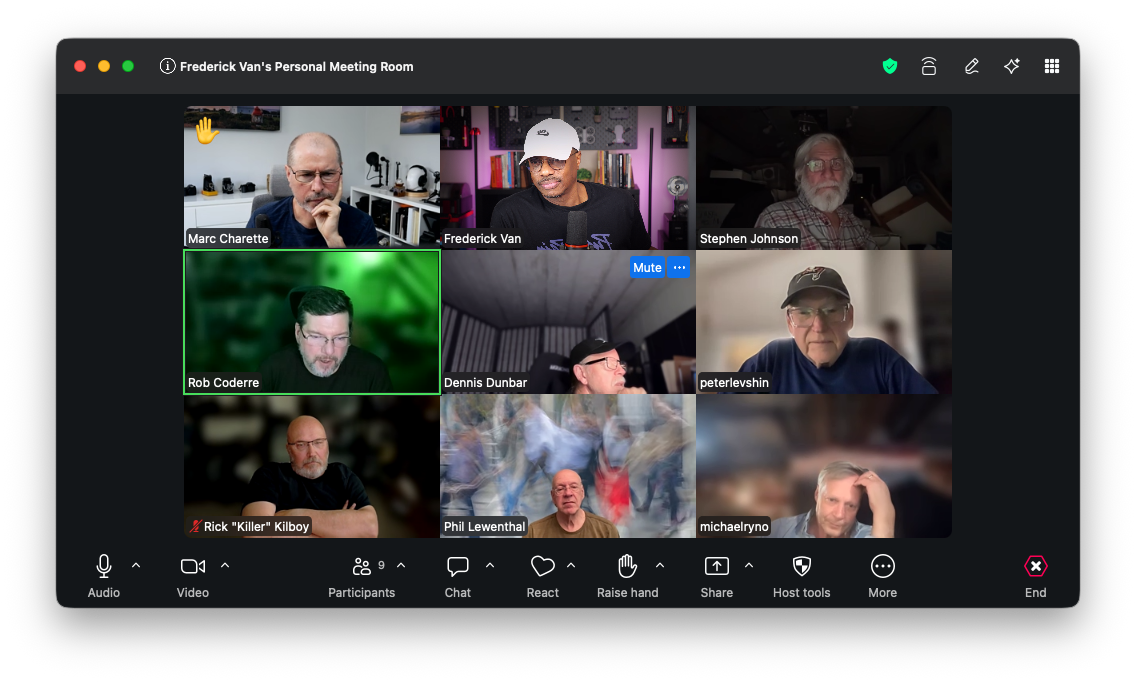
Marc Charette, Frederick Van, Stephen Johnson, Rob Coderre, Dennis Dunbar, Peter Levshin, Rick “Killer” Kilboy, Phil Lewenthal, Michael Ryno
Resources Shared
- LA Center of Photography: AI and Alternative Photography (Phil)
- Sean Tucker — “Meaning in the Making” (Marc)
- Marc’s White Paper: “Authentication Challenges in 360° Photospheres and Virtual Tours” (shared in chat — includes Bridge/ACR workflow)
Watch the Replay
This event has ended.